
The Tapestry of Life

Updated: Apr 14
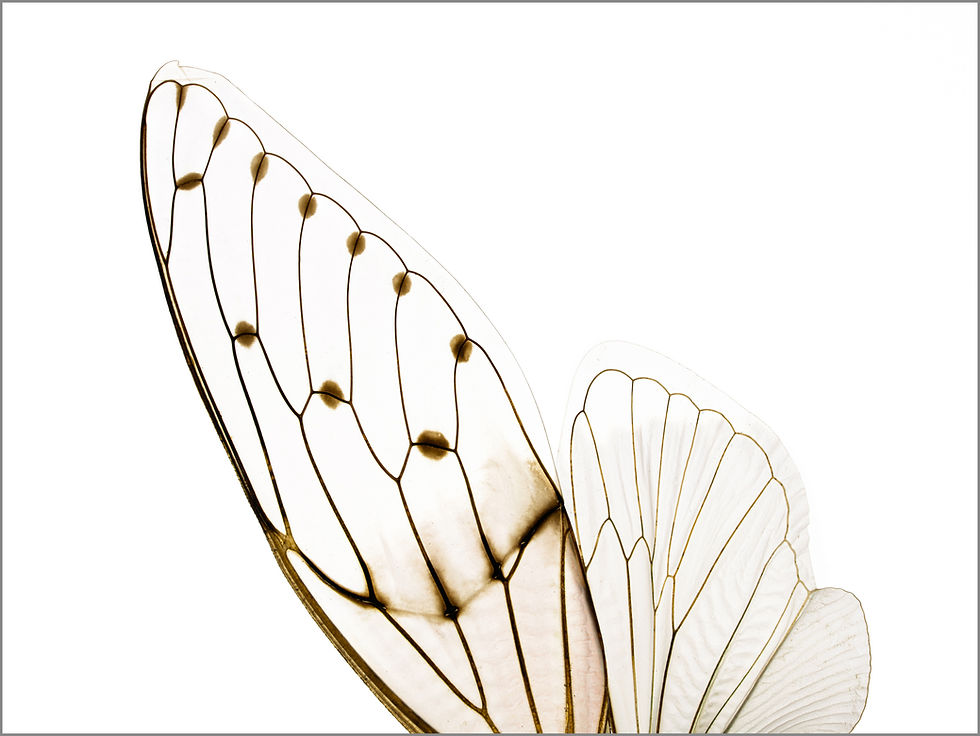
For my birthday, I asked for and received one of the most unusual gifts you could imagine: insect wings. My wife found a dried specimen available on Etsy, and when I unwrapped my gifts I was happy to open a box containing a nicely preserved Cicada Orni, commonly known as the Ash Cicada.
Now I was able to take close-up photographs of the wings to showcase their geometric splendor.

To be honest, I haven’t always viewed insects in a favorable light. For much of my life, I saw them as a nuisance to be swatted, squashed or sprayed with pesticides to kill them. My strong aversion may stem from a childhood trauma involving dead grasshoppers. When I was four or five years old, my father made me remove their crunchy bodies from my little wading pool by spearing them with a long straight pin. This was a horrifying experience for me.

Like so many people, I came to view insects as vile, disgusting intruders. I never thought of them as beings with awareness or cognitive abilities. I never considered them vital to the planet’s survival. And I certainly never thought of them as something to be admired for their beauty.
Over time, though, I’ve come to appreciate how intelligent these small creatures can be. Studies show that they exhibit learning, memory, spatial navigation and even tool use. Insects pollinate over 75% of our crops, and they're a vital food source for a variety of animals in the food chain – making them a crucial part of earth's ecosystem.

Thanks to photography, I've even gained a new perspective on the beauty of insects. When I shot these close-up photos of the Cicada's wings, I marveled at the patterns I saw. To me, they're as spectacular as any stained glass masterpiece designed by Frank Lloyd Wright. The wings are a transparent, aerodynamic, geometric wonder to behold.

With my newfound respect for insects, I approach them now with more kindness and less hostility than I did before. If I see an insect in the house, my first instinct isn’t to kill it. If it’s a lone bug that isn’t causing a threat to our home or bodies, I make an effort to take it outside, if possible, and set it free.

Admittedly, it's easier to feel empathy and concern for dolphins, chimps and koala bears than it is to summon these same feelings for a "lowly" bug. But it's helpful to remember that insects are inextricably tied to all life on our planet. And there's much more to them than we realize; scientists are continually learning more about the complexity and sophistication of communal behaviors in the insect world.
Entomologist May Berenbaum understood the interconnections between us when she said, "As we unravel the secrets of insects, we discover the threads that weave the tapestry of life on Earth."
What a magnificent tapestry it is.
If you enjoyed this reflection, consider sharing it with a friend or posting to your social media account.


